
Parking and Maneuvers for Learner Drivers: A Complete Practical Guide
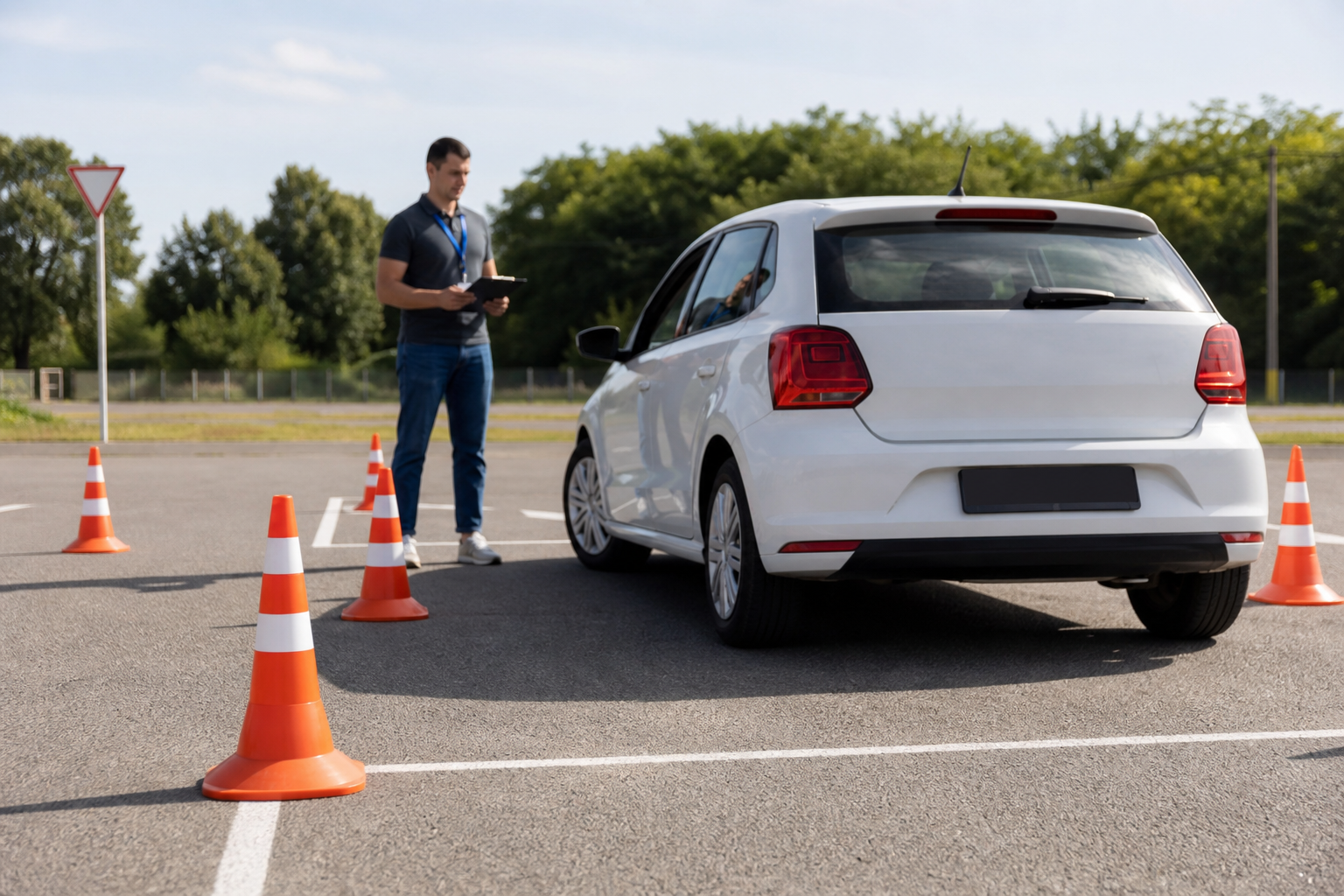
Parking and low-speed maneuvers are essential driving skills. They require good observation, gentle control of the vehicle and enough patience to make safe decisions. A maneuver should never be rushed: the objective is to position the vehicle accurately while protecting pedestrians, other road users, the vehicle and surrounding property.
This guide explains the main parking techniques and turning maneuvers for learner drivers. The exact method may need to be adapted to the vehicle, road markings, available space and local instructions. Learners can also review the driving courses available at Karim Driving School and study the Lebanon driving theory test and traffic signs to build a stronger foundation.
Before starting any parking maneuver
Prepare before moving. Check that your seat, mirrors and steering position are comfortable, fasten your seat belt and identify the space or turning area. Reduce your speed early and observe the entire environment rather than looking only at the space immediately beside the vehicle.
- Check the interior mirror and both exterior mirrors.
- Look over your shoulder into the relevant blind spot before changing direction or moving close to another road user.
- Signal early when appropriate, but remember that a signal does not replace observation.
- Use a very low speed and be ready to stop.
- Watch for pedestrians, children, cyclists, motorcycles, opening doors and vehicles approaching from behind.
Parallel parking step by step
Parallel parking is usually performed beside the curb between two vehicles or within a marked roadside space. Choose a space that gives you enough room to enter without forcing another road user to stop suddenly.
- Approach slowly with a safe distance from the parked vehicles. Signal when appropriate and stop beside the vehicle in front of the space, leaving enough side clearance to avoid contact.
- Check the interior mirror, side mirrors and blind spots. Make sure the area behind and beside the vehicle is clear.
- Begin reversing slowly and steer toward the space according to your instructor’s reference points. Continue checking the rear, sides and front corner of the vehicle.
- As the rear of the vehicle enters the space, gradually unwind the steering so the vehicle follows the curb rather than pointing sharply toward it.
- When the front of the vehicle has cleared the vehicle ahead, steer gently in the opposite direction to bring the front into the space.
- Straighten the wheels and adjust the position if necessary. Finish with a safe, practical gap from the curb and surrounding vehicles.
Do not rely on one fixed number of steering turns or one reference point for every car. Vehicle length, seating position, visibility and turning circle differ. Learn the sequence with your instructor, then confirm it using mirrors and direct observation.
Reverse parking into a marked space
Reverse parking can improve visibility when leaving the space, but the safest method depends on the layout and surrounding traffic. Position the vehicle so that the turn into the space is wide and controlled.
- Approach the space slowly and select a position that gives the rear of the vehicle a clear path.
- Check the mirrors and blind spots before beginning to reverse. Look for pedestrians or vehicles crossing behind the space.
- Start reversing at walking speed and steer smoothly toward the space when the vehicle reaches the correct turning point.
- Alternate your attention between the direction of travel, both side mirrors and the front corners. Do not stare at only one mirror.
- Straighten the wheels as the vehicle becomes aligned with the lines or curb.
- Stop when the vehicle is fully within the space and leaves reasonable clearance around it.
If the approach is poor, stop and correct it. A controlled readjustment is safer than continuing while the vehicle is badly positioned.
Forward, angle and perpendicular parking
Forward parking
For forward parking, approach slowly and leave enough room to turn without cutting across an adjacent space. Steer progressively toward the center of the space, then straighten the wheels before stopping. Check both sides because the front of the vehicle swings outward during a turn.
Angle parking
Angle spaces often make entry easier because the vehicle turns into the space at an angle. Follow the direction indicated by the layout and avoid crossing into adjacent spaces. As you enter, check the line on each side and straighten only when the vehicle is properly aligned. When leaving, be especially careful: the vehicle may need to move in a different direction from the angle of entry, and nearby pedestrians or vehicles may be difficult to see.
Perpendicular spaces
For a perpendicular space, use a wide, slow approach and monitor the front corners. The rear wheels follow a tighter path than the front of the vehicle, so do not assume that the vehicle will clear an obstacle simply because the front has passed it.
Three-point turns and U-turns
Three-point turns
A three-point turn is used to change direction where the road is too narrow for one continuous turn, only where it is safe and permitted. Before starting, check traffic in all directions and identify a clear area without pedestrians, parked vehicles or hidden entrances.
- Stop close to the appropriate side of the road while maintaining safe clearance.
- Check around the vehicle, signal where appropriate and move forward slowly while steering toward the opposite side.
- Stop before reaching the edge or any obstacle, then select reverse as required.
- Check all directions again before reversing. Reverse slowly while steering in the opposite direction.
- Stop when there is enough room, then complete the turn while maintaining observation and control.
The number of movements may vary with the road width and vehicle size. Never begin a three-point turn merely because it is convenient; traffic signs, road markings, visibility and local rules must allow it.
U-turns
Make a U-turn only where it is legal, visible and safe. Never perform one near a crest, bend, junction or other location where approaching road users may not see you in time. Check signs and markings, signal appropriately and give priority according to the applicable traffic rules. If there is any doubt, continue to a safer place where you can change direction without obstructing traffic.
Reversing safely
Reversing requires extra care because the view behind the vehicle is limited. Before moving, walk around the vehicle when appropriate and check for low obstacles, children, animals and objects that may not appear in the mirrors. Keep the speed slow enough to stop immediately.
Use the rear window, interior mirror and side mirrors together. Looking over your shoulder can help you confirm the path, but it does not remove the need to check mirrors and blind spots. If your view becomes blocked, stop and reposition the vehicle or obtain appropriate assistance. Do not rely solely on sensors or a reversing camera.
Mirrors, blind spots and vehicle positioning
Good positioning begins before the maneuver. Keep the vehicle at a safe, consistent distance from the curb or parked vehicles, and avoid moving so close that a small steering error causes contact. When passing a parked vehicle, give yourself enough room for its doors and for the movement of cyclists or motorcycles.
Blind-spot checks are particularly important before moving off, turning, changing position, reversing and opening a door. A quick mirror glance is not enough: the correct check depends on the direction of movement, and a direct shoulder check may be needed.
Steering control at low speed
At low speed, use smooth steering rather than sudden movements. Keep both hands ready to control the wheel and avoid crossing your hands unnecessarily during basic exercises. Release or unwind the steering progressively when the vehicle begins to straighten. Use the brake gently and do not allow the vehicle to roll faster than your observation permits.
Practise finding the vehicle’s straight-ahead position. After a turn, confirm through the wheel position and the vehicle’s path that the tires are aligned. In a manual vehicle, coordinate clutch control, brake control and gentle acceleration as taught by your instructor; in an automatic vehicle, manage the brake carefully and avoid pressing the accelerator unnecessarily. Karim Driving School’s automatic driving course and manual driving course can help learners practise the controls relevant to their vehicle.
Judging distance from curbs and other vehicles
Distance judgement improves with reference points and repeated observation. Use the curb line, parking lines and the position of nearby vehicles as guides, but do not treat any reference point as universal. Your view changes with the vehicle and seat position.
- Use both side mirrors to compare the gap on each side.
- Look ahead and behind the vehicle, not only at the nearest corner.
- Remember that the front and rear corners swing differently as you steer.
- When uncertain, stop, secure the vehicle and check rather than guessing.
- Practise at walking speed in a quiet, suitable area under instructor supervision.
Parking on hills and slopes
On a slope, prevent unintended movement before leaving the vehicle. Stop in a safe position, apply the parking brake correctly and select the appropriate transmission setting for the vehicle. Keep the wheels positioned as instructed for the road layout and local rules, particularly when a curb is present. The precise procedure can vary, so ask a qualified instructor and confirm current local requirements.
When starting on an incline, take time to establish control before releasing the brake. Avoid rolling backward or forward into traffic, a curb or another vehicle. On a downhill or uphill road, increase your observation distance and do not let the gradient encourage excessive speed.
Narrow streets and busy areas
In a narrow street, reduce speed early and identify a safe passing or stopping area. Avoid entering a space that leaves no escape if another vehicle approaches. Keep checking mirrors for cyclists, motorcycles and vehicles behind you, and be prepared to stop to allow the road situation to resolve.
In busy areas, do not let waiting traffic pressure you into a rushed maneuver. A short pause to observe is safer than turning across a pedestrian path or reversing without a clear view. Maintain a safe gap from parked vehicles and look for people stepping into the road between cars.
Common beginner parking mistakes
- Starting the maneuver too quickly or steering before completing the observations.
- Looking only at the parking space and missing pedestrians, traffic or the front corner.
- Relying on mirrors without checking the blind spot.
- Turning the steering wheel too sharply and then correcting repeatedly.
- Finishing at an angle, over a line or too close to another vehicle.
- Forgetting that the front or rear of the vehicle swings outward.
- Continuing when the position is clearly wrong instead of stopping and resetting.
- Leaving the vehicle unsecured on a slope.
- Allowing pressure from other drivers to affect safe decisions.
Staying calm during parking exercises
Break every maneuver into three stages: observe, move slowly and reassess. Breathe normally, keep your eyes moving and accept that a small correction is part of learning. If you become confused, stop safely, apply the brake and ask your instructor to explain the next step. Calm observation is more valuable than speed.
Practical driving-exam tips
Before a practical assessment, practise the maneuver in different spaces and with different approaches rather than memorising one location. Demonstrate deliberate observation, safe speed, accurate positioning and proper control. Use signals when appropriate, respond to pedestrians and traffic, and stop if the situation becomes unsafe.
Listen carefully to the examiner’s instruction and ask for clarification if it is not understood, without making a sudden movement. A maneuver that needs a safe correction is preferable to contact with a curb, vehicle or obstacle. For broader preparation, review Karim Driving School’s driving theory test preparation guide and consider professional lessons through the school’s driving services.
Final parking and maneuver checklist
- Is the maneuver legal, permitted and appropriate for the location?
- Have you checked mirrors, blind spots and the full surrounding area?
- Are pedestrians, cyclists, motorcycles and approaching vehicles accounted for?
- Is the vehicle moving slowly enough to stop immediately?
- Are steering, braking and transmission controls smooth?
- Is the vehicle correctly aligned and clear of curbs, lines and other vehicles?
- Are the wheels and parking brake set appropriately before leaving the vehicle?
- If the position is not correct, can you stop and make a controlled correction?
Parking is not a test of speed. It is a demonstration of observation, planning and precise control. Regular supervised practice will make these skills more natural and help you become a safer, more confident driver.