
Manual vs Automatic Driving: Which Is Better for Learner Drivers?
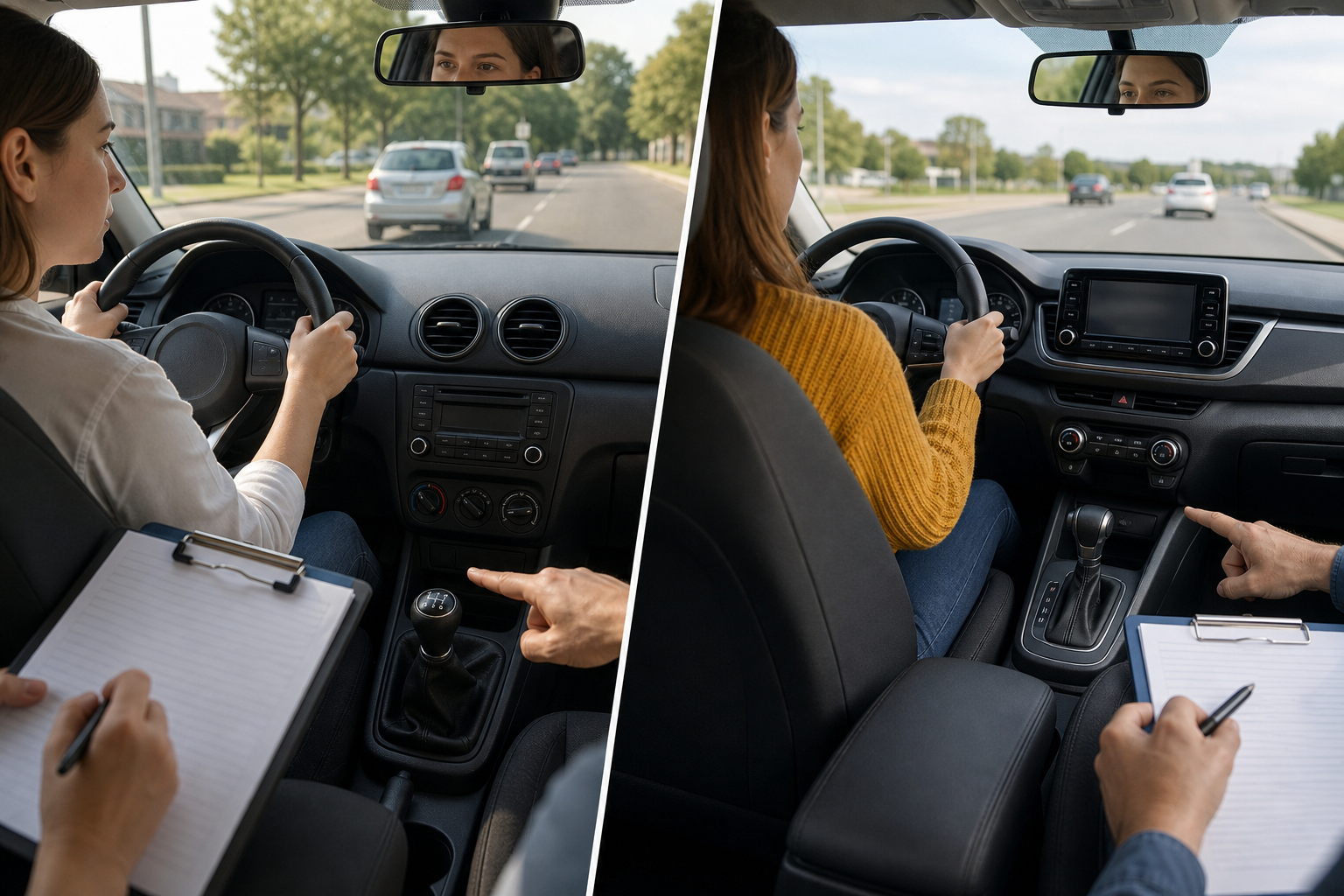
Choosing between manual and automatic driving is one of the first important decisions for a learner driver. Both transmission types can help you become a safe, responsible and confident road user, but they require different skills and offer a different driving experience. The best choice depends on your learning goals, the type of traffic you face, your comfort with coordination and the vehicles you expect to drive in the future.
This guide explains the main differences between manual and automatic cars, the advantages and disadvantages of each, common learner mistakes and practical ways to choose the right option. You can also compare Karim Driving School’s Manual Driving Course and Automatic Driving Course before booking lessons.
What is the difference between manual and automatic transmission?
In a manual car, the driver selects the gears and operates the clutch. The clutch temporarily separates the engine from the gearbox so that the driver can move away smoothly, change gear and stop without stalling. The driver normally uses the left foot for the clutch and the right foot for the brake and accelerator.
An automatic car changes gears itself. The driver generally selects Park, Reverse, Neutral or Drive and controls the accelerator and brake with the right foot. There is no clutch pedal and no routine manual gear changing. Modern automatic systems may still change ratios in different ways, but the essential learner experience is simpler: the car manages gear selection while the driver concentrates on steering, speed and observation.
Advantages and disadvantages of manual driving
Advantages of a manual car
- More direct control: Selecting the gear yourself can help you manage speed and engine response, especially on inclines or winding roads.
- Strong understanding of vehicle behaviour: Learning clutch control, gears and engine response can develop broad driving skills.
- Potential flexibility: A learner who is comfortable with manual driving may feel prepared to drive manual vehicles, subject to the applicable licensing rules and current official requirements.
- Driver involvement: Some people enjoy the active coordination and feeling of control that a manual gearbox provides.
Disadvantages of a manual car
- There is more coordination between the clutch, gear lever, accelerator, steering and observation.
- Stop-and-go traffic can become tiring because of frequent clutch use and gear changes.
- Incorrect clutch control may cause stalling, jerky movement or unnecessary clutch wear.
- Hill starts require additional preparation and timing.
Advantages and disadvantages of automatic driving
Advantages of an automatic car
- Easier initial learning: Without clutch and routine gear changes, beginners can devote more attention to road position, signs, mirrors and hazards.
- Greater comfort in traffic: Automatic transmission reduces repeated clutch work in congested streets.
- Smoother workload: The driver can focus on steering, safe following distance and speed control.
- Convenient parking: Low-speed manoeuvres can feel less complicated because there is no clutch pedal to coordinate.
Disadvantages of an automatic car
- The driver has less direct control over gear selection, although many systems offer manual or low-gear modes.
- A learner may become too dependent on the transmission and neglect observation, speed planning or vehicle positioning.
- Automatic vehicles may feel unfamiliar when moving between different models, because transmission responses and controls can vary.
- Driving options may depend on the licence conditions and current rules in the jurisdiction where the licence is issued. Confirm those details with the relevant official authority.
Which is easier for a beginner?
For most beginners, an automatic car is easier at the start because it removes clutch control, gear selection and many stalling situations. This can be particularly helpful for learners who feel anxious, have difficulty coordinating several controls or regularly drive in heavy urban traffic.
However, “easier” does not automatically mean “better” for everyone. Manual training can provide a wider range of mechanical and coordination skills. A learner who wants to drive different vehicles, enjoys a more involved driving style or is prepared to practise gradually may prefer manual lessons. The important point is to choose the transmission that supports safe, consistent learning rather than choosing based only on speed or convenience.
Essential manual skills: clutch, gears and hill starts
Finding the clutch biting point
To move away smoothly, press the clutch fully, select first gear and check the surroundings. Release the clutch slowly until you feel the car begin to take up drive—the biting point. Pause briefly, add gentle accelerator pressure if needed and continue releasing the clutch progressively. Sudden release can stall the engine, while holding the clutch at the biting point for too long can create unnecessary wear.
Changing gears
Gear changes should be planned rather than rushed. Observe the road, decide whether you need more acceleration or control, ease off the accelerator, press the clutch fully, select the appropriate gear and release the clutch smoothly while returning to the accelerator. The correct gear depends on the vehicle, road, slope and traffic; learners should follow their instructor’s guidance instead of relying on one fixed speed for every car.
Starting on a hill
A hill start requires preparation and calm coordination. Apply the parking brake when appropriate, select first gear and find the biting point. Check the road and traffic, release the parking brake when the car is ready to move and add gentle acceleration while releasing the clutch progressively. Avoid rolling backwards and avoid holding the vehicle on a slope by slipping the clutch. Your instructor can demonstrate the safest method for the specific training vehicle.
Common mistakes when learning manual driving
- Looking down at the gear lever instead of keeping attention on the road.
- Releasing the clutch too quickly or using excessive accelerator input.
- Resting a foot on the clutch pedal while driving.
- Forgetting to check mirrors and surroundings before changing gear or moving off.
- Selecting a gear too high for a steep incline or too low for the road conditions.
- Changing gear late because the driver waits until the engine sounds uncomfortable.
- Using the clutch to control the car continuously during slow manoeuvres instead of balancing speed carefully.
- Panicking after a stall. A stall is a learning event: secure the car, restart calmly and reassess.
Common mistakes when learning automatic driving
- Using the left foot on the brake, which can lead to abrupt or confusing pedal inputs. Most drivers should use the right foot for both brake and accelerator.
- Moving the selector from Drive to Reverse or Park before the vehicle has stopped completely.
- Pressing the accelerator too sharply during low-speed manoeuvres.
- Relying on the automatic transmission instead of checking mirrors, blind spots and the direction of travel.
- Allowing the car to creep without maintaining proper control near pedestrians, walls or other vehicles.
- Forgetting to select Park, apply the parking brake when appropriate and follow the vehicle manufacturer’s instructions when finishing a journey.
- Assuming every automatic car responds identically. Practise the controls and braking response of each vehicle before driving it in a busy area.
Fuel efficiency and everyday driving
Fuel consumption depends on many factors, including vehicle design, engine size, traffic, tyre condition, load, maintenance, weather and driving style. It is not accurate to assume that every manual car is more economical than every automatic car. Modern automatic vehicles can manage gear changes efficiently, while a manual vehicle can also use fuel unnecessarily if the driver accelerates harshly, selects unsuitable gears or leaves the engine idling.
For either transmission, accelerate smoothly, anticipate traffic, maintain correct tyre pressure according to the vehicle guidance, avoid unnecessary loads and follow the manufacturer’s maintenance recommendations. In daily driving, comfort and concentration also matter: a transmission that reduces stress in your normal routes may help you maintain better attention and smoother speed control.
City driving, traffic and parking
Automatic cars are often comfortable in congested city traffic because the driver does not repeatedly operate a clutch. They can also simplify slow reversing and parking, but the driver must still use careful observation and very gentle pedal pressure. Automatic creep is not a substitute for active control.
Manual cars can be equally safe in cities when the driver has good clutch control and plans ahead. In traffic queues, avoid riding the clutch and leave enough space to move smoothly. During parking, use low speed, frequent observations and small steering inputs. For both transmission types, check mirrors and blind spots, look for pedestrians and cyclists, and never allow the convenience of the gearbox to distract you from the surroundings.
Which transmission may suit different learners?
- Choose automatic lessons if you want to concentrate quickly on observation and road awareness, regularly face heavy traffic or find clutch coordination stressful.
- Choose manual lessons if you want to develop clutch and gear skills, expect to use manual vehicles or enjoy a more involved driving experience.
- Consider your regular environment: steep roads, frequent congestion, long journeys and parking conditions can influence which transmission feels practical.
- Consider your learning style: some learners progress better by reducing the number of tasks at first, while others prefer to learn a broader set of controls from the beginning.
- Ask a qualified instructor: an assessment lesson can help identify whether your difficulty is the transmission itself or simply a skill that needs more practice.
Safety tips for both manual and automatic cars
- Adjust the seat, mirrors and head restraint before moving.
- Wear your seat belt and ensure passengers do the same.
- Scan well ahead, check mirrors regularly and look for vulnerable road users.
- Keep a safe following distance and adapt speed to visibility, surface and traffic.
- Use signals early and make sure they match your actual manoeuvre.
- Never use a mobile phone or allow another distraction to take your attention from driving.
- Practise new skills in a suitable area with a qualified instructor before applying them in complex traffic.
- Learn the controls of the specific vehicle, including its parking brake, transmission selector and driver-assistance features.
How professional lessons build confidence
Professional instruction gives learners a structured progression instead of asking them to manage every skill at once. An instructor can demonstrate the correct sequence, choose an appropriate practice location, explain why a mistake occurred and increase difficulty gradually. Lessons can cover moving off, stopping, junctions, lane position, hill starts, parking, emergency awareness and independent decision-making.
Good coaching also develops habits that transfer between vehicles: effective observation, smooth braking, appropriate speed, safe spacing and calm responses to mistakes. Explore the school’s driving courses or contact Karim Driving School to discuss which training route fits your goals. Theory knowledge is equally important; review the driving theory test preparation guide to strengthen your understanding of signs and safe decisions.
Final comparison checklist
Before choosing, ask yourself:
- Do I want to learn clutch control and manual gear selection?
- Will I mainly drive in heavy city traffic or on open roads?
- Do I feel more comfortable reducing coordination tasks at the beginning?
- Which type of vehicle am I likely to use after training?
- Am I willing to practise hill starts and gear changes patiently?
- Have I considered current licensing conditions and confirmed them through the relevant official source?
- Can a professional assessment lesson help me make the decision?
There is no single transmission that is best for every learner. Automatic driving may offer a simpler start and greater ease in traffic, while manual driving can build broader control skills and suit learners who want a more active driving experience. Whichever option you choose, consistent practice, good observation and professional guidance are more important than the gearbox itself.